
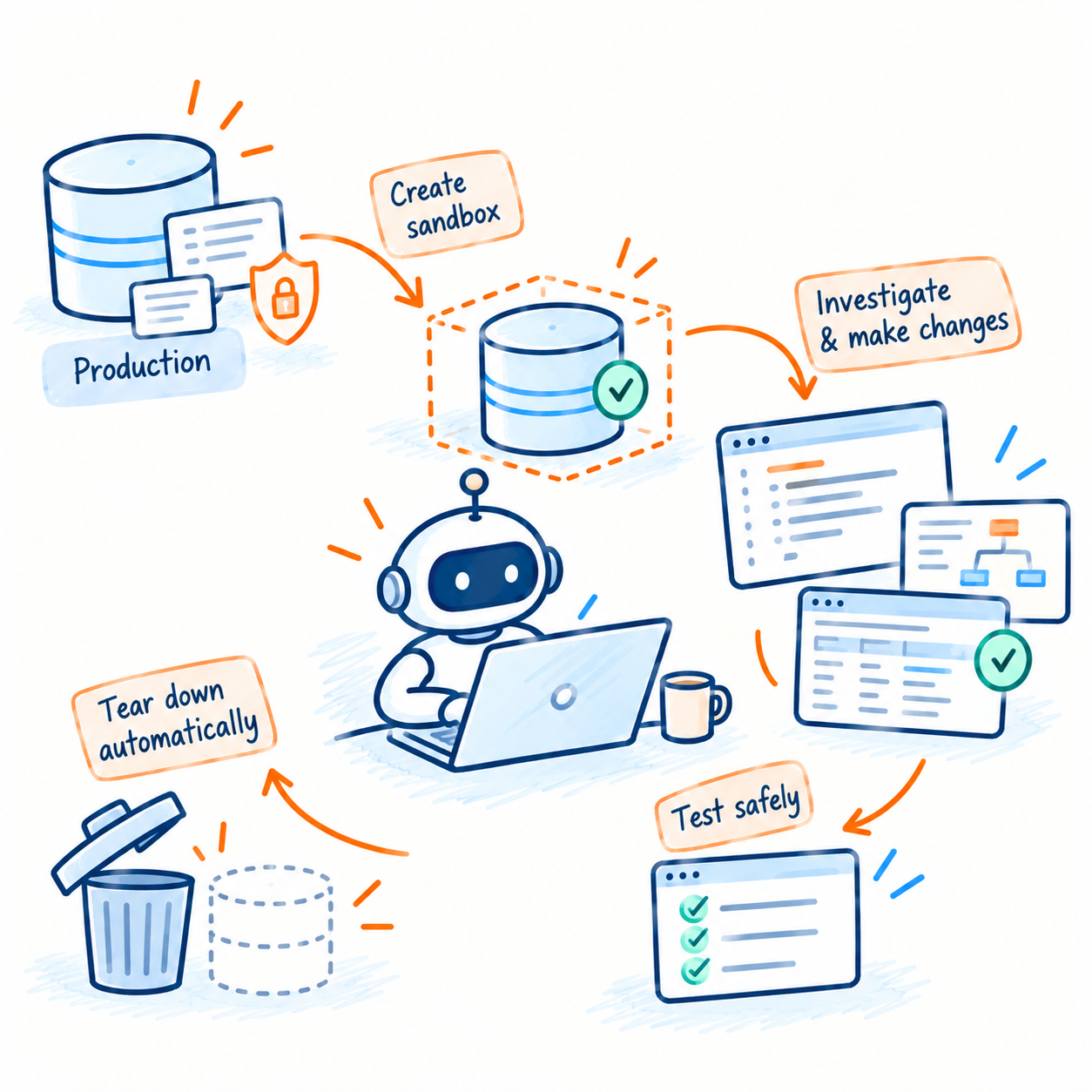
Everyone wants to leverage modern AI to its fullest. Everyone in R&D has witnessed the rise of Claude Code, Cursor, Codex, and Windsurf/Devin to code and prompt in natural language. Small shops are quick to adopt these technologies and run with them, yet moderately sized businesses and enterprises keep hitting the same wall on the way to the promised land of agentic coding. That wall is the database, and the fix is a new layer of infrastructure: database sandboxes for agentic coding.
Why Agentic Coding Breaks at the Database Layer
One of the biggest challenges is database anxiety. Even before agentic coding, developers lived through the horror of database related outages, from blackouts caused by failed migrations to brownouts caused by queries regressing. Database outages are notorious for being uniquely painful because recovery can take hours, days, and sometimes weeks of painstaking debugging under pressure. That was true when actual people wrote the code. Now imagine the mischief AI-generated code could cause, and the risks involved when velocity increases tenfold.
There are three reasons the database problem gets worse, not better, with AI in the loop:
- AI has tunnel vision. People carry a world view and the inherent decency to coordinate with peers when they recognize a risky database change. AI just charges forward toward its goal.
- AI occasionally goes off the reservation. Many teams have watched an agent drop entire tables or databases unprompted, which then needs a human in the loop to reset. That is the polar opposite of the self-serve Agent Experience (AX) we have in mind.
- Jason Lemkin, a tech entrepreneur and the founder of the SaaS community SaaStr, chronicled his experiment with Replit across a series of social media posts. While testing Replit's AI agent and development platform, he watched it make unauthorized changes to live infrastructure, erasing data for more than 1,200 executives and over 1,190 companies.
- Humans cannot keep up with the volume. When velocity increases and 10x more code rolls out to production, humans have a small chance of tracking the impact of change on the biggest kitchen sink of all, the system of record.
Why Staging and Preview Environments Fall Short for AI Coding Agents
The industry has traditionally solved this with non-production environments such as staging and preview, augmented by a hodge-podge of tooling and the DBA's favorite pastime, the whack-a-mole game of fixing production. With agentic coding, the classic solutions fall short.
The industry is rightfully itching to lean in. Everyone is gunning to give AI the infrastructure it needs to develop and iterate rapidly, and current efforts focus on setting agentic coders up with the environment they need to write, iterate over, and test code. But on the heels of the coding environment, any codebase that heavily manipulates a system of record runs straight into the database problems above, at a scale orders of magnitude larger than it faced just a year ago.
For these codebases, the hyperengineering focus of the near future (the engineering of AX, or Agent Experience) will be on standing up data environments so agentic coders can explore and experiment autonomously.
The Three Tenets of Database Sandbox Infrastructure for Agentic Coding
The usual conclusion is that database sandbox infrastructure, also known as preview or prod branches, is enough for the unlock. We maintain that sandboxing is a necessary component with a couple more pieces still missing before it is sufficient. At Baseshift, we believe this infrastructure must have three tenets.
1. Sandboxes: Fast, Cheap, Fresh Data Environments
Ephemeral database environments that are autonomously created, reset, and shut down by AI coding agents and developers alike, at scale.
2. Factual Transparency Into Database Changes
A clear answer to how code written or modified by AI translates into database changes. For example, did a pull request create or modify a table? Was a query's behavior changed, and if so, which one?
3. A PR Gate for Database Change Risk
Independent of who or what wrote the code, agentic or human, something needs to warn whoever approves the pull request of a looming risk.
There are many ways to implement each tenet. Implementing them separately is a terrible waste of time and tokens, and the maintenance burden is doubly so. Baseshift's solution is smart database sandboxes.
Baseshift DubHub: Database Sandboxes That Are Just Files
Baseshift DubHub is a full, end-to-end, all-batteries-included solution to the logistical challenge. It covers everything from mapping sensitive data in production, to copying it with masking and subsetting, to taking and packaging snapshots, to making them available to consumers as writable clones. Those clones reach consumers through a variety of methods: as fully self-contained Docker images (database binaries, extensions, and data), and on servers through a self-serve UI, CLI, REST, and MCP.
DubHub snapshots are unique because they do not sit on top of, or rely on, any outside storage infrastructure. There is no AWS EBS, EFS, or S3 dependency, clones are not RDS instances, and there is no need for special drivers or file systems.
Baseshift snapshots are just files. They are literally directories full of files that you can move around like any other set of files. You can put them in S3 and you can copy them from one machine to another. For now we package them as Docker images and push them to standard Docker registries like AWS ECR, JFrog Artifactory, and Harbor. From there you can pull the image and run locally or anywhere Docker images run, including your own Kubernetes or a cloud-managed cluster like AWS EKS. The data environment becomes one more Lego brick, alongside your other services.
Baseshift's server can also spin up writable clones directly, hosting many instances on a single server. Because snapshots are just files, their data can live in a server's local file system, in shared storage like NFS or EFS, or in object storage like S3. Scaling out compute for server-based clones becomes trivial: provide more compute with access to the same files. Agentic coders control their own data sandboxes through MCP or a CLI, so they can autonomously launch, reset, and shut down their databases, taking the human out of the loop.
Supported Databases
Baseshift supports a variety of popular databases. It generates snapshots using standard, as-downloaded binaries of PostgreSQL, MySQL, MariaDB, and MongoDB, with more to come. It does not need forks or special flavors. It also supports data environments that combine databases, such as PostgreSQL and MongoDB, or PostgreSQL and MySQL.
Smart Sandboxes: Built-In Audit, Change Reporting, and Risk Analysis
Baseshift's sandboxes are smart because they go one step further: they transparently record every operation run against them. That recording unlocks three capabilities.
Audit for Compliance
When used with sensitive production data, the recording itself is a useful compliance asset. For example, if there is a requirement to detect and prevent unwarranted data extraction, the audit can feed early warning systems for data loss prevention (DLP).
Factual Change Reporting
AI can generate large volumes of code, so reviewing all of it to understand the resulting database change is daunting. Schema changes tend to be obvious through schema management tools like Flyway, but query changes are less obvious, especially when an ORM generates them. It helps to have something outside your codebase that sees every change made during testing, without relying on code-level tooling. For example, factual change reporting can surface an ORM that quietly introduced an N+1 query, a migration that added a non-concurrent index, or a query that changed its WHERE clause and now scans an entire table.
Database Change Risk Analysis
Beyond noticing the raw factual changes to schemas and queries, the riskiest part of any database-related change is how it interacts with and impacts everything else running on the database. Risk analysis flags those interactions before merge: a new index that locks a hot table during creation, a query whose plan regresses into a full table scan, or a migration that holds a long lock and blocks live transactions. Surfacing this at the PR gate turns an after-hours incident into a review comment.
Unlocking Agentic Coding Where It Is Scariest
Combining all three, audit, factual change reporting, and risk analysis, provides comprehensive mitigation of observable risk. The Baseshift vision is to mitigate all possible risk and to alleviate the anxiety of rolling out AI-generated code that affects databases. That is how you unlock agentic coding where it is scariest: in real-world systems running at scale, powering the critical operations of a modern organization.