
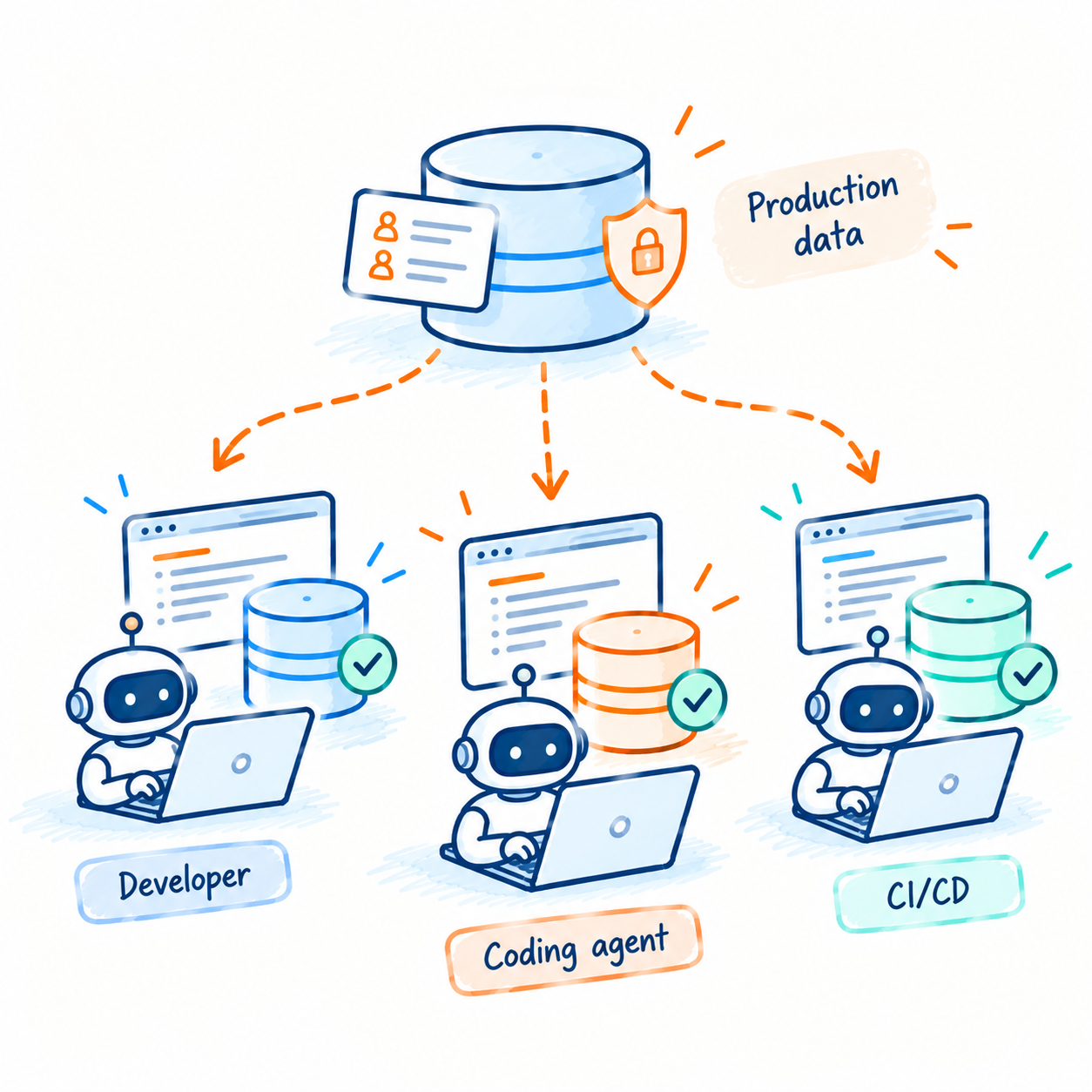
Why a shared database fails with agents
A coding agent modifies state in ways code review does not catch. It will drop tables, delete rows, and rewrite data, and it will sometimes wipe whole files or databases. On a shared instance, that hits every other user of the instance.
The agent usually recognizes the mistake right after it makes it, but the damage is already done. Reset is the obvious remedy, and agents rarely reach for it today because there is no environment where resetting is cheap and safe.
With an ORM, the executed SQL is generated at runtime. Reading the application code does not tell you what runs against the database, so review does not bound what an agent does at the data layer.
When the shared environment is slow to rebuild, one destructive change blocks the whole team until someone restores it.
Alternatives
Shared staging is a single failure domain. It was sized for a handful of people, not for a fleet of agents making destructive changes against the same instance.
Synthetic or mock data does not reproduce production scale, value distributions, null density, or missing indexes, so scale-dependent bugs do not show up against it.
Per-agent dump, restore, and mask is too slow to run per agent. An initial sanitized copy of a roughly 1TB database takes a couple of hours, so teams make one shared copy instead.
One sandbox per agent
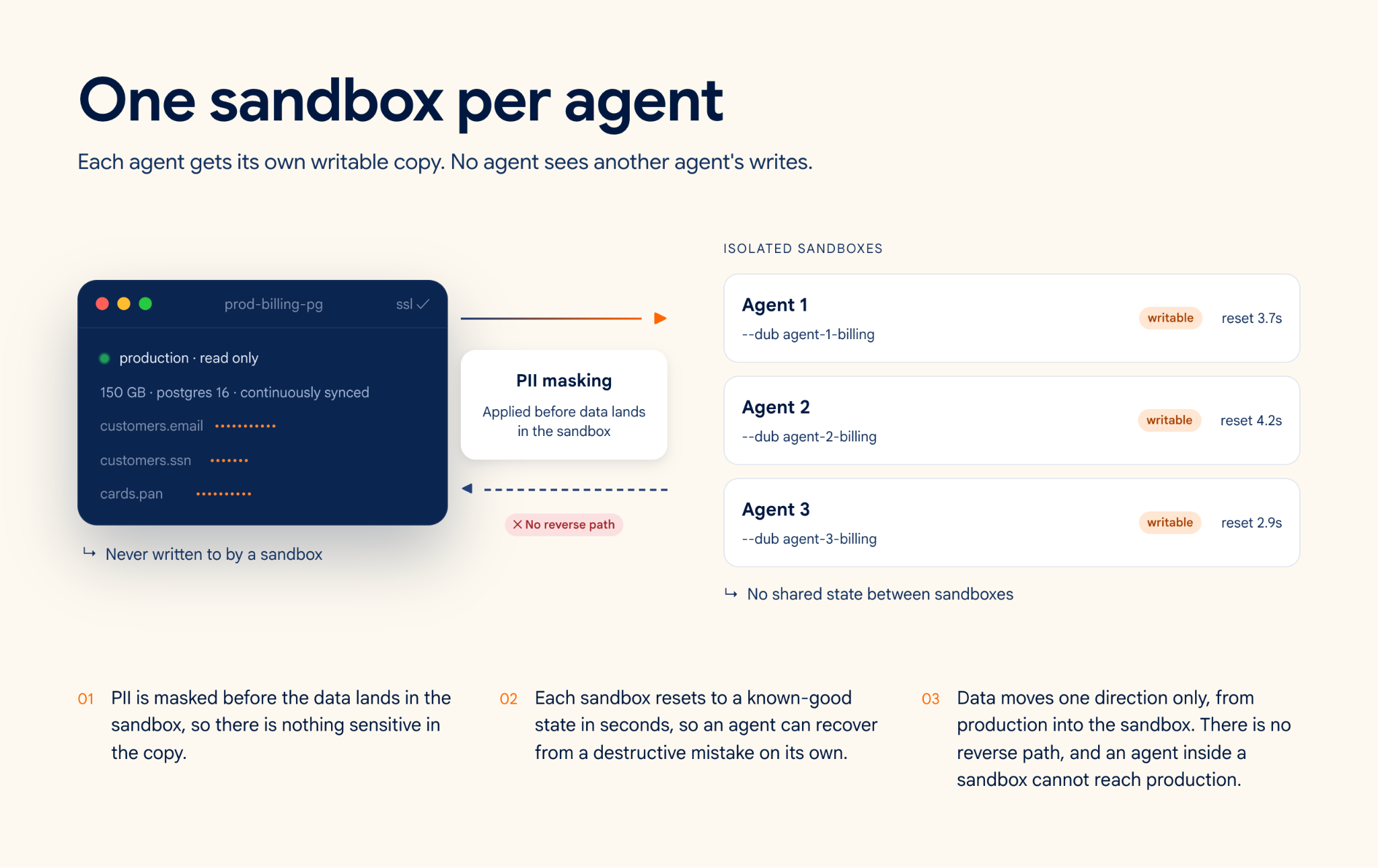
Each agent gets its own writable copy. No agent sees another agent's writes.
PII is masked before the data lands in the sandbox, so there is nothing sensitive in the copy.
Each sandbox resets to a known-good state in seconds, so an agent can recover from a destructive mistake on its own.
Data moves one direction only, from production into the sandbox. There is no reverse path, and an agent inside a sandbox cannot reach production.
How Baseshift builds it
A snapshot is a directory of binary files, not a block-device snapshot, a shared filesystem such as EFS or NFS, or a cloud snapshot. No filesystem driver or special OS support is required. It can move to object storage or another account or region, and can be packaged as a Docker or OCI image containing the database binaries, extensions, and data.
Clones are writable layers over one shared read-only snapshot. The snapshot data is not duplicated per clone, so a single machine runs many writable instances at once, each in its own container.
Snapshots form a chain: a base plus a delta per day, and a clone can start from any point in it. Daily change on a typical database is 1 to 2 percent, so only changed blocks transfer. Snapshots compress about 3 to 1 and stay compressed while in use. A standard Docker image must be decompressed before it can run; a Baseshift snapshot does not, so it uses less disk on the machine running it.
Masking is applied inline during replication. Data is modified according to the policy before it reaches the replica, so the replica arrives sanitized. Baseshift supports multiple databases, including Postgres, MySQL, and MongoDB or DocumentDB, and the replica runs the standard engine rather than a fork. Multi-database support is a key differentiator.
Agents request sandboxes programmatically, with no human step.
Security properties
Both data-touching components run inside your network: a server hosting the masked replica, and a proxy doing the masking. The source connection is to a read replica, so there is no load on the primary.
The masking policy is customer-owned. Baseshift can scan the tables and a data sample to suggest a policy, and that scan and suggestion run entirely on your infrastructure using local regexes. The data sample never reaches Baseshift. You control the final policy, assigned per column, per table, or by template.
Start with Baseshift
Baseshift provisions masked, per-agent database sandboxes from your production Postgres, with the one-way flow and policy controls described above. Get started at baseshift.com.